


X (Formerly Twitter | Facebook | YouTube | Christian Warrior Training | Christian Warrior Bible Study
Open Source Intelligence Summary · Public Distribution
BLUF
Southern Sinaloa has escalated from faction warfare into a sustained explosives campaign: in the same ten day window that state forces arrested the Los Chapitos plaza boss for the region, Escuinapa absorbed drone bomb attacks on police and soldiers, a seizure of more than 550 IEDs, a car bomb, and the desertion of roughly 40 municipal police officers. On the political front, the U.S. case against Sinaloa’s state government advanced in a New York courtroom while reporting surfaced investigations into two more sitting governors, putting cartel capture of Mexican state institutions squarely in front of U.S. prosecutors.
Key Judgments
Highly Likely: The Mazatlán to Escuinapa corridor will remain the most dangerous operating environment in Mexico for security forces through the near term. The 550 plus IED stockpile indicates explosives production at campaign scale, the El Gabito arrest opens a contested succession for the southern plaza, and the desertion of roughly 40 Escuinapa municipal officers shows local security capacity already breaking.
Likely: Cartel factions are shifting from incidental to deliberate targeting of police and military. The Culiacán state police commander assassination, the Nahuatzen ambush that killed five Civil Guard officers, the Luvianos section chief killing, the Hermosillo municipal agent killing, and repeated drone bomb attacks on state police and Army personnel in Escuinapa all occurred within two weeks. Officers working DTO targets on either side of the border should treat this as a posture shift, not a cluster of isolated incidents.
Likely: Additional U.S. indictments of Mexican officials are coming. The presiding judge’s statement that a wave of accusations is to come, Merida’s 40 years to life exposure creating cooperation incentive ahead of the August 4 hearing, and reported investigations into the sitting governors of Sonora and Tamaulipas all point the same direction, with U.S. visa revocations functioning as the leading indicator of who is under scrutiny.
Likely: The CJNG and Knights Templar dispute in Michoacán’s Tierra Caliente is reigniting into sustained violence, evidenced by the four dead CJNG members in Paracuaro and layered on top of the existing CJNG, Cárteles Unidos, and El Abuelo faction conflicts in the state.
Possible: Each new U.S. indictment will further chill state level Mexican cooperation with U.S. law enforcement, with the Campos prosecution in Chihuahua demonstrating the federal penalty for cooperating and no offsetting protection for officials who work with U.S. partners.

Domestic Nexus (US)
New York, NY (DOJ SDNY / DEA): “Wave of Accusations to Come” in Sinaloa State Government Case Former Sinaloa Security Secretary Gerardo Merida Sanchez appeared June 1 for a preliminary hearing in the Southern District of New York case charging him, Governor on leave Ruben Rocha Moya, Senator Enrique Inzunza Cazarez, the mayor of Culiacán, and six other current and former Sinaloa officials with conspiring with Los Chapitos to import narcotics in exchange for bribes and political support. Merida remained silent while the judge described the evidence as abundant and stated there would be a wave of accusations to come, setting the next hearing for August 4. Merida faces 40 years to life, and analysts expect him to cooperate in exchange for leniency. Prosecutors allege he accepted more than 100,000 dollars in monthly cash bribes from Los Chapitos, directed officers not to arrest faction members, and leaked advance warning of raids on labs and safehouses.
Source | [Hearing reporting via OSAC Mexico Weekly News Roundup, June 2-8]
Laredo, TX (CBP / Border Patrol): Migrant Encounter Surge and Railcar Deaths Tied to Cartel Freight Exploitation The Laredo sector recorded an 86 percent spike in migrant encounters compared to April 2025, prompting deployment of more than 200 additional federal agents, a surge since extended 30 days. Migrants from Mexico and Honduras were found dead inside a Union Pacific freight boxcar, and cartel linked facilitator Mayra Huerta was charged with harboring. Reporting describes multiple incidents involving 20 to 41 people packed into hidden freight and semi truck sleeper compartments along Interstate 35, with stash house operators positioned as expendable nodes along the corridor. Former Border Patrol Chief Jason Owens characterized cartel control of cross border illicit movement in the sector as near total.
Houston, TX (HSI / FGR): Ikon Midstream Search Warrant Ties U.S. Fuel Exporter to CJNG Huachicol Network HSI executed a search warrant at the offices of Houston based fuel exporter Ikon Midstream, and Mexico’s FGR opened a parallel investigation into a CJNG linked fuel smuggling network estimated to have cost Mexico’s treasury 600 billion pesos in tax losses. Reporting ties the exporter to at least 13 Mexican client companies across more than 300 transactions, including CJNG linked shell importers Intanza and Azteca Cone, which held SAT import registrations despite having no verifiable infrastructure or energy ministry permits. The scheme used identical falsified Harmonized System codes on both the U.S. export and Mexican import sides of each transaction. The U.S. Senate is concurrently moving bipartisan fuel theft legislation.
Multi-County, GA (State / Federal Task Force): Seven Indicted in Prison-Directed Fentanyl and Meth Pipeline Seven defendants were indicted in a fentanyl and methamphetamine distribution network spanning seven Georgia counties, including two hidden production labs. The network was directed by Luis Alfonso Ramirez, an imprisoned gang leader running the supply chain via contraband cellphone from Washington State Prison, through Mexican cartel connected external distributors identified in reporting as Norteño affiliated. Seizures included 35 kilograms of methamphetamine, 3.5 kilograms of fentanyl, and 145,000 dollars in cash. Four of the seven indicted had previously been deported.
Hawthorne, CA (ICE / FGR): Former Mexican Soldier Tied to Ayotzinapa Case Detained, Deportation Sought Mexico’s FGR announced it will seek the deportation of former SEDENA soldier Enrique Martínez Chávez, 32, after U.S. authorities notified it of his arrest in Hawthorne, California, where he failed to prove legal status. Martínez Chávez is subject to an active Mexican arrest warrant for alleged involvement in the September 2014 enforced disappearance of the 43 Ayotzinapa students in Guerrero, a case long tied to the Guerreros Unidos trafficking organization and corrupted local security forces. He is being held at the Adelanto processing center pending immigration proceedings.
Cartel Watch (Mexico)
Cártel de Sinaloa
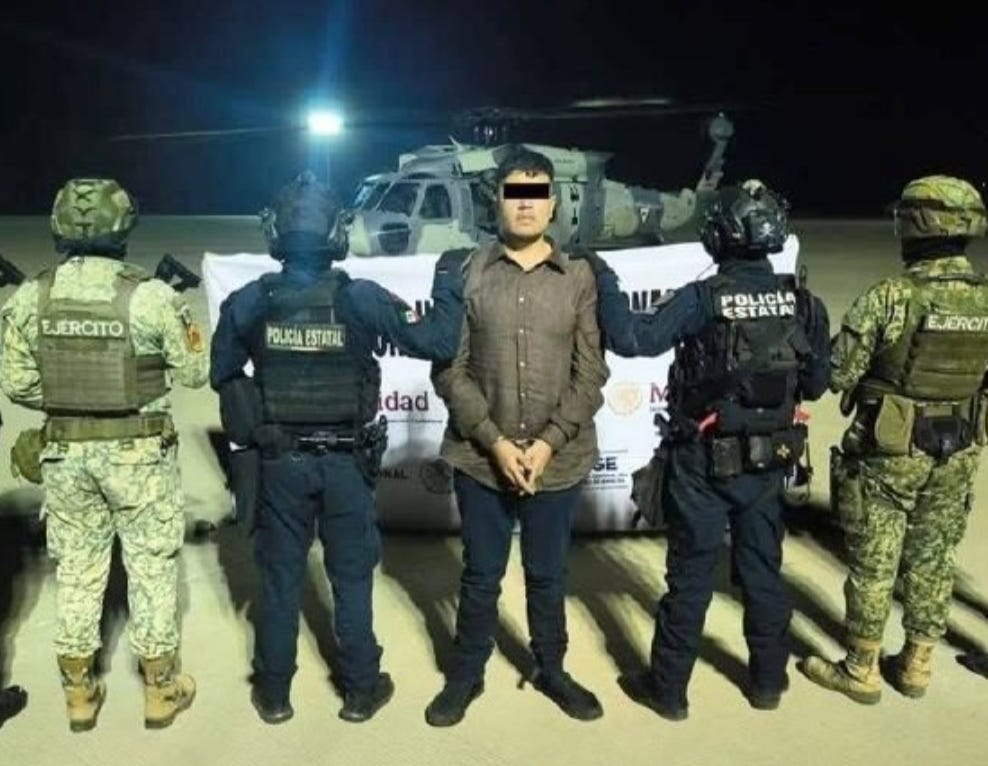
Sinaloa (Los Chapitos) — Mazatlán, Sinaloa: “El Gabito” / “El 80,” Southern Sinaloa Plaza Boss, Arrested Sinaloa state security forces arrested Gabriel Nicolás Martínez Larios, alias “Gabito” or “El 80,” around 8:30 p.m. on Monday, June 1 in the Real del Valle residential complex in Mazatlán. News reporting and multiple narco messages identify him as the Los Chapitos leader for the southern region of Sinaloa. He is alleged to have ordered the January 2026 kidnapping and killing of ten employees of a silver mine in Concordia, Sinaloa. The week before his arrest, a narco banner signed by El 80 was left in El Rosario alongside two dismembered bodies, rejecting a La Mayiza recruitment overture and declaring his cell would remain “100% Chapo.”
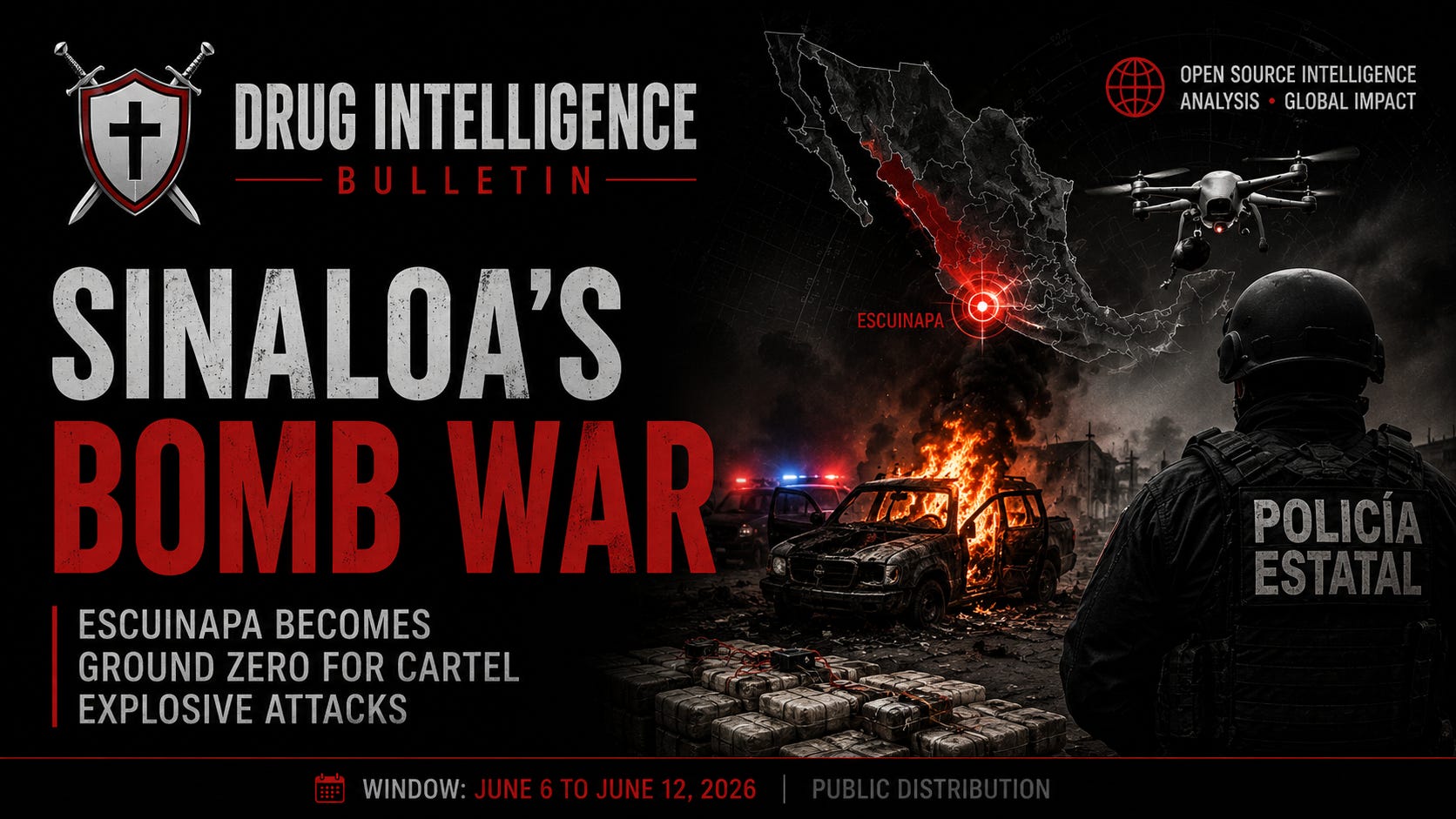
Sinaloa — Escuinapa, Sinaloa: Sustained Explosives Campaign Includes Drone Bomb Attacks on Security Forces, 550+ IEDs Seized, and a Car Bomb Escuinapa, in the southern plaza vacated by the El Gabito arrest, absorbed a week of escalating explosive attacks. On June 3, residents reported explosions and attacks across the municipality, with a State Police patrol reportedly targeted on the Tepic to Mazatlán highway; Mayor Victor Diaz Simental confirmed the violence but denied state forces were the target. On June 3 and 4, State Police and Army personnel securing a weapons cache in the Emiliano Zapata neighborhood, 13 automatic weapons, a modified 203 type grenade launcher attachment, 26 loaded magazines, and ballistic plate vests, were attacked twice with explosives dropped from drones, damaging an official vehicle and forcing authorities to extract the seized arms by Mexican Air Force aircraft. On June 7, security forces seized more than 550 IEDs in the municipality, including landmines and munitions built to be dropped from drones, and that evening residents reported a fresh series of explosions, allegedly drone attacks. On June 9 around 3:00 a.m., a car bomb detonated near the 10 de Mayo neighborhood, destroying an electric line and cutting power to hundreds of families, with no casualties; the location had no apparent soft targets nearby, raising the possibility of premature detonation. Proceso reports roughly 40 Escuinapa municipal police officers have deserted under the pressure, leaving security in the municipality to the State Police, Army, and National Guard. Car bombs remain rare in Mexico, with roughly 20 recorded since 1994 according to University of Coahuila researcher Víctor Manuel Sánchez Valdés; no attribution has been established for the campaign.
550+ IEDs, Proceso | Drone attacks on forces, El Universal | Car bomb, Borderland Beat
Sinaloa — Culiacán, Sinaloa: State Preventive Police Commander Assassinated Juan Pedro Arámburo García, commander of the Sinaloa State Preventive Police, was shot and killed on the morning of Sunday, May 31 in an ambush while driving through the 10 de Mayo neighborhood of Culiacán. The killing of the state force’s operational commander occurred amid the ongoing Chapitos and Mayiza conflict in the capital. No arrests were reported at publication.
Sinaloa — Culiacán, Sinaloa: Defense Secretary Oversees Troop Surge as Homicides Run at Double Pre-War Rate National Defense Secretary Ricardo Trevilla and other senior officers arrived in Culiacán to oversee the deployment of 90 additional troops in pacification operations. Sinaloa recorded 522 homicides in the first five months of 2026, double the yearly totals the state registered before the internal Sinaloa Cartel war erupted in September 2024. On June 6, authorities located two bodies in separate areas of Culiacán, one decapitated in El Diez and one in the Ferrocarrilera neighborhood.
[Source: OSAC Mexico Weekly News Roundup, June 2-8]
Sinaloa (Los Chapitos / La Mayiza) — El Rosario, Sinaloa: Dismembered Bodies Left With Narcomanta Rejecting Faction Switch On May 27, two dismembered bodies were found in plastic tubs in El Rosario accompanied by a narco banner signed by La Chapiza rejecting recruitment overtures from La Mayiza. The victims were identified as young men forcibly recruited from Coahuila, consistent with reporting that La Mayiza is feeding inexperienced conscripts from Coahuila and Durango into Chapitos controlled southern Sinaloa. The banner is attributed to the El 80 cell arrested days later in Mazatlán.
Source (graphic imagery at source)
Sinaloa (Los Chapitos) — Nogales, Sonora: Nephew of “El Chapo” Arrested With Active U.S. Extradition Order Federal forces arrested Isai “N,” identified as a nephew of Joaquín “El Chapo” Guzmán, in Nogales, Sonora on May 26 in an operation coordinated by SEDENA, FGR, and the National Guard. He was detained with an active U.S. extradition order. The arrest occurred in the same corridor and timeframe as the Los Salazar arrests below.
Sinaloa (La Mayiza / Los Salazar) — Nogales, Sonora: Senior Los Salazar Operative and Trafficking Coordinator Arrested Federal forces arrested Jesús Said Rochín Aguilar, a senior operational commander within Los Salazar, La Mayiza’s armed enforcement wing, alongside his partner Claudia Marina Ruiz Carreón, identified as the primary logistics and administrative coordinator for the cell’s migrant trafficking operations. The arrests on May 26 disrupt a key node in the Sonora to Arizona smuggling corridor for both narcotics and human smuggling. Los Salazar realigned to La Mayiza in August 2024, deepening ties with the Cártel Independiente de Caborca and reshaping the corridor’s balance.
Cártel Jalisco Nueva Generación (CJNG)
CJNG — Zitácuaro, Michoacán: Army Patrol Ambushed, Narco-Blockades Follow Arrests CJNG fighters ambushed a Mexican Army patrol in Zitácuaro on May 30, and five suspects were detained. Within hours, retaliatory road blockades using burning vehicles and felled trees were set across multiple access points in the municipality, temporarily severing the Morelia to Zitácuaro highway and access routes to Aputzio de Juárez before Guardia Civil intervention restored order by mid afternoon.
CJNG — Paracuaro, Michoacán: Four Alleged CJNG Members Found Dead in Marked Vehicle Amid Knights Templar Dispute On the morning of June 4, four men were found dead inside a vehicle marked with the CJNG acronym in the town of Los Blancos, Paracuaro. The victims wore tactical equipment and died of firearm injuries. Reporting places the killings in the context of the territorial dispute between CJNG and the Knights Templar in the Tierra Caliente.
[Source: OSAC Mexico Weekly News Roundup, June 2-8]
CJNG — Ecatepec, Estado de México: SEMAR Operation Nets 24 Arrests Against Urban Cell SEMAR’s Operativo Baluarte in Ecatepec yielded seven initial arrests in early May, followed by a second sweep bringing the total to 24, including a 16 year old. Seizures included at least four firearms, luxury vehicles, and ammunition. The operation disrupted a CJNG cell operating in one of the most volatile urban zones in the country.
Michoacán: Cárteles Unidos and Tierra Caliente Factions
Attribution Not Established — Nahuatzen, Michoacán: Ambush Kills Five Civil Guard Officers, Five Wounded The Michoacán Secretariat of Public Security confirmed five Civil Guard officers killed and five wounded in an ambush Wednesday, June 10 near the community of La Mojonera, on the road connecting Nahuatzen and Zacapu. The attack began around 3:00 p.m. when officers requested backup while under fire from a criminal cell using high caliber weapons. Police from nearby municipalities, Civil Guard personnel, and federal forces responded, and a ground and air operation to locate the attackers is ongoing. Reporting has not established which organization carried out the attack.
Michoacán — Uruapan, Michoacán: Civil Guard Officer and Former Prosecutor’s Office Official Arrested in Mayor Manzo Assassination Authorities arrested a Civil Guard officer identified as Juan Luis “N,” “Comandante Gary,” and a former Uruapan Prosecutor’s Office official identified as Héctor “N” for alleged involvement in the November 1 assassination of Uruapan Mayor Carlos Manzo. The arrests place an active duty state security officer and a former justice official inside the plot against a sitting mayor.
[Source: OSAC Mexico Weekly News Roundup, June 2-8]
El Abuelo / Tierra Caliente Faction — Tepalcatepec, Michoacán: Senior Operator “El Repollo” Arrested in Helicopter-Supported Raid Federal forces arrested Alonso “El Repollo” on May 27 in Tepalcatepec, identifying him as a senior operator overseeing clandestine labs and extortion networks for Juan José Farías Álvarez, “El Abuelo.” Armed civilians erected obstacles attempting to impede the transfer of the detainee, but the helicopter supported federal cordon defeated the blockade attempts.
El Abuelo Farías Faction (attributed) — Aquila / Pómaro, Michoacán: Three Community Officials and a Teacher Killed in Ambush Three communal land authorities and a teacher were killed May 27 in an ambush attributed in reporting to the El Abuelo Farías faction. The killings sparked indigenous community protests and road blockades in the coastal Michoacán region.
Attribution Not Established — Apatzingán, Michoacán: U.S. Citizen Killed in Targeted Motorcycle Attack A May 30 homicide victim in Apatzingán was confirmed to be a U.S. citizen, identified in reporting only as Brandon L, 21. Armed men reportedly attacked him directly while he rode a motorcycle in the Aviación neighborhood. His death was the second of a U.S. citizen in Mexico over the May 30 to 31 weekend, alongside the Los Cabos fatality below.
[Source: OSAC Mexico Weekly News Roundup, June 2-8]
La Barredora (Tabasco)
La Barredora — Tabasco: Violence Climbs Despite Leadership Decapitation, Structure Assessed Intact El Universal reported that despite the September 2025 arrest of La Barredora leader and former State Security Secretary Hernán Bermúdez Requena, official data show homicides up 35 percent from September through April, a record 54 victims in a month, extortion up 88 percent, drug distribution up 21.3 percent, and threats up 21.6 percent. The homicide trend runs counter to the national decline, and analysts assess La Barredora’s operating structure remains intact. The report also cites the weakening of CJNG and the Sinaloa Cartel, following the reported February 2026 death of CJNG founder Nemesio Oseguera Cervantes, “El Mencho,” and the ongoing Sinaloa internal war, as destabilizers of the local criminal landscape.
[Source: OSAC Mexico Weekly News Roundup, June 2-8]
Baja California Sur
Attribution Not Established — Los Cabos, BCS: American Killed in Shootout, Follow-Up Operation Kills Three Gunmen, U.S. Travel Alert Issued A Saturday night shootout between gunmen and the Mexican military in Santa Anita, Los Cabos on May 30 left a U.S. citizen from California dead, five civilians wounded, and two soldiers injured. In a follow up operation on June 2 in San José del Cabo, authorities killed three gunmen and arrested a fourth while targeting the criminal organization responsible. The U.S. Consulate General in Tijuana subsequently issued a travel alert for Los Cabos, acknowledging the violence occurred outside traditional tourist areas while urging increased caution for U.S. citizens transiting the area.
Other Incidents
Attribution Not Established — Nanchital, Veracruz: Journalist Roxana Guzmán Kidnapped From Her Home on Video Security camera video circulating the morning of June 2 shows armed men breaking into the Nanchital home of Roxana Berenice Guzmán Ramírez, director of the news outlet Pulso Informativo del Sureste, threatening her brother at gunpoint and taking her against her will. Veracruz State Attorney Lizbeth Jiménez said the FGE search is concentrated in Nanchital, Moloacán, and Cuichapa, and that footage review identified a suspect vehicle and possible escape routes. Reporting notes Guzmán’s husband was murdered in 2017, after which she left the state for several years before returning to found her outlet. Mexico remains the most dangerous country not at war for journalists, with at least nine murdered in 2025.
Attribution Not Established — Luvianos, Estado de México: State Security Section Chief Kidnapped and Killed Miguel Raymundo Martínez Monroy, Section XVI Chief of the State Security Secretariat headquartered in Luvianos, was kidnapped and then found shot dead, per June 2 reporting. At least ten police officers have been killed in Estado de México so far this year.
[Source: OSAC Mexico Weekly News Roundup, June 2-8]
Attribution Not Established — Tenancingo, Estado de México: Mayor Reports Kidnapping and Escape Tenancingo Mayor Nancy Nápoles Pacheco stated that on May 31 she was kidnapped from her home by two men and a woman who demanded a 40 million peso ransom. She reported escaping without paying. The case adds to a pattern of direct criminal pressure on sitting municipal officials in the state.
[Source: OSAC Mexico Weekly News Roundup, June 2-8]
Attribution Not Established — Chilpancingo, Guerrero: Four Decapitated Bodies Left at State Congress On June 4, four decapitated male bodies were found abandoned inside a car at the back entrance of the Guerrero State Congress in Chilpancingo. No further details or attribution had been released at publication. The placement at a state legislative building is consistent with messaging directed at government rather than rivals.
[Source: OSAC Mexico Weekly News Roundup, June 2-8]
Attribution Not Established — Hermosillo, Sonora: Municipal Police Agent Killed in Bar Attack On the evening of June 6, a gunman opened fire on customers inside Club Juárez in downtown Hermosillo, wounding two men and a woman, and killed a Municipal Police agent while fleeing. The attack was captured on security camera footage.
[Source: OSAC Mexico Weekly News Roundup, June 2-8]
Attribution Not Established — Zacatecas, Zacatecas: Former State Investigative Police Director Kidnapped Video published by Grupo Fórmula and journalist Carlos Jiménez shows the May 28 kidnapping of Gustavo Domínguez Saldívar, former Director of the Zacatecas State Investigative Police, with hooded men forcing him into a vehicle in the state capital. He had not been located at publication.
[Source: OSAC Mexico Weekly News Roundup, June 2-8]
Attribution Not Established — Ciudad Juárez, Chihuahua: Four Bodies Left With Anti-Crystal Narco Message On June 1, authorities located the bodies of four men with signs of violence on the Panamerican highway in Ciudad Juárez, accompanied by a narco message warning against the sale of crystal methamphetamine and referencing 108 bags of product left at the scene. The message frames the killings as plaza enforcement against retail meth dealers; the signing organization was not identified in reporting.
[Source: OSAC Mexico Weekly News Roundup, June 2-8]
Attribution Not Established — Tijuana, Baja California: Narco Banner Threatens State Police and Grupo Firme Vocalist A narco banner posted in Tijuana on June 1 threatened Baja California state police officers, accusing them of stealing 180 kilograms of cocaine, and threatened Eduin Caz, vocalist of the band Grupo Firme, over music referencing criminal rivals. The banner is a claim by its authors and has not been independently attributed.
Political-Criminal Nexus
Sinaloa / Sonora / Tamaulipas: U.S. Investigations Reach Sitting Governors as Morena Closes Ranks Following the April SDNY indictment of Sinaloa’s governor and nine officials, a June 3 Los Angeles Times report stated the U.S. government is investigating two additional sitting governors, Sonora’s Alfonso Durazo and Tamaulipas’s Américo Villarreal, both of the ruling Morena party, and that both have had their U.S. visas revoked. Both state governments called the report false, though Tamaulipas’s spokesman shifted from “not a single proof” to “no verifiable evidence” within the same statement. Morena’s national leader said Governor on leave Rocha Moya and Senator Inzunza will remain party members absent proof, while indicted former Sinaloa investigative police chief Alberto Jorge Contreras Núñez, “El Cholo,” filed an amparo against the UIF’s freezing of his accounts. President Sheinbaum questioned whether the visa revocations of Morena politicians amount to an interventionist tool, and a Massive Caller poll found 44.5 percent of respondents associate Morena with the term narco party, the highest of any party.
[Source: OSAC Mexico Weekly News Roundup, June 2-8] | Indictment background, DOJ
Chihuahua / Morelos: Selective Federal Enforcement Pattern Tied to Cartel Alignment Mexico’s FGR is pursuing Chihuahua Governor Maru Campos after she refused to testify regarding CIA officers who were operating in Chihuahua, while MORENA moves proceedings in the Chamber of Deputies to strip her immunity on treason allegations tied to her cooperation with U.S. anti cartel operations; the Chihuahua State Prosecutor’s Office has now turned over information on the CIA officers to the FGR. Concurrently, El Universal reported that state and federal investigations tie 14 to 15 Morelos municipalities to organized crime through the Cártel de la Jefa, a Sinaloa Cartel linked organization, with implicated figures ranging from former politicians to sitting mayors, including the Cuautla mayor who sought an amparo to avoid arrest over meetings with plaza boss “El Barbas.” Reporting characterizes the combined pattern as selective enforcement that rewards cartel alignment and punishes cooperation with U.S. law enforcement.
TTPs and Technology
Drone-Delivered IEDs Spreading Across Factions and Theaters. Cárteles Unidos (R5) deployed a DJI type drone fitted with an improvised bomb against a CJNG vehicle near Valle de Juárez, Jalisco on May 25, the first confirmed offensive drone use by R5 in the state, compressing a capability gap previously held by CJNG. In Sinaloa, the Escuinapa attacks on security forces and the seizure of drone droppable munitions and landmines mark standardization of aerial IEDs in the intra cartel war: Milenio reports 56 drones seized between October 2024 and March 2026 across strategic municipalities including Culiacán, Badiraguato, Choix, Escuinapa, Concordia, San Ignacio, and Rosario, and SEDENA data tracked by InSight Crime show IED seizures nationally climbing from three in 2020 to 2021 to over 1,375 in 2022 and rising since. Secretary of State Marco Rubio publicly flagged cartel drone use this week as a capability that could eventually be turned against U.S. interests.
R5 strike | Sinaloa drone seizures, Milenio | IED trend, InSight Crime
Online Voluntary Recruitment of Minors, Michoacán. Michoacán State Prosecutor Carlos Torres Pina confirmed the FGE detected four cases of organized crime recruitment of minors in May alone, stressing that per collected evidence the recruitment is not forced: the minors are contacted online and leave willingly with recruiters. The FGE says it has identified multiple recruitment methods through open source intelligence collection but did not specify them. This complements established forced recruitment pipelines such as CJNG’s Rancho Izaguirre site, indicating parallel voluntary and coerced intake channels.
[Source: OSAC Mexico Weekly News Roundup, June 2-8]
Cryptocurrency Laundering Architecture, Los Chapitos. OFAC designated Jesús Alonso Aispuro Félix on May 20, identifying him as the primary financial intermediary converting Los Chapitos trafficking proceeds into crypto assets under network chief Armando de Jesús Ojeda Avilés. Aispuro Félix processes bulk transfers through cryptocurrency wallets while associates such as Rodrigo Alarcón Palomares handle physical cash recovery on U.S. streets. The network launders through front businesses including a Chihuahua restaurant, Gorditas Chiwas, and a private security firm, using family members as testaferros.
Coordinated Bilateral Customs Falsification. The CJNG linked huachicol fiscal network filed identical false Harmonized System codes, lubricating oils in place of diesel and naphtha, on both the U.S. export and Mexican import ends of fuel transactions. A former CBP cargo security director called the technique among the most complex and sophisticated tax evasion schemes yet encountered, and the matching codes on both sides indicate deliberate coordination between the exporter and the cartel linked importer. The template, phantom client companies sharing operational playbooks, is potentially replicable across other commodity sectors. The physical risk side of the huachicol economy surfaced June 4 in Tepeaca, Puebla, where at least four tanker trucks at a stolen fuel storage lot exploded, injuring three and forcing evacuation of nearby schools and a hospital.
Disinformation Riding Real Incidents. Within hours of the Tepeaca fuel explosion, fabricated posts claimed Puebla was under U.S. air attack against cartels, amplified by a verified X account posing as a U.S. Homeland Security news outlet. The episode shows how real kinetic events inside Mexico are being exploited for U.S. intervention narratives in near real time, a pattern worth anticipating around any high visibility enforcement action during the World Cup window.
[Source: OSAC Mexico Weekly News Roundup, June 2-8]
Open-Source Cultural Products as Intelligence. The FBI arrest of Irving Froilán León Alvarado, “El 18,” an Ovidio Guzmán bodyguard, followed narcocorridos released in 2023 and 2025 that publicly identified him by name, hometown, role, and weapons before the Bureau built its case. The prosecution ultimately rested on an ex girlfriend cooperator, a photo laden cellphone, and Facebook messages dating to 2015. The case illustrates how narcocorridos and social media inadvertently generate actionable identification data on protected echelon personnel.
Emerging Drug Threats
Fentanyl-Xylazine Mix at Semi-Industrial Scale, Ohio. A Butler County task force arrested Cincinnati distributor Antonio Green, with suspected Sinaloa ties, in possession of more than 150 grams of a fentanyl and xylazine mixture, roughly 75,000 potentially lethal doses, alongside a hydraulic kilogram press and professional processing equipment. The xylazine adulteration and pressing capability at the local distribution level indicates semi industrial preparation downstream of the importation layer, a pattern worth flagging to patrol and overdose response units in the Miami Valley and comparable markets.
Mexican Cartel Production Migrating to Africa. U.S. Africa Command’s General Dagvin Anderson testified before the Senate Armed Services Committee in May that 11 of 12 recently disrupted drug laboratories in Africa had Mexican cartel members physically on site, including Sinaloa Cartel members at South Africa’s largest ever lab bust. Production of methamphetamine and fentanyl precursors at these sites is destined for European, Middle Eastern, and U.S. markets. The trend points to deliberate export of manufacturing expertise to reduce domestic exposure in Mexico.
Caribbean Cocaine Routes Shifting East, Increasingly Bound for Europe. Sustained U.S. military interdiction operations launched in September 2025 are pushing departure corridors eastward toward Guyana, Suriname, and Brazil, away from patrolled zones near Venezuela and the ABC islands. A growing share of Caribbean transiting cocaine is now destined for Europe via West Africa, with U.S. Africa Command observing a nearly sixfold increase in trans Atlantic cocaine flow since 2024. The West African node’s vulnerability is illustrated by Sierra Leone, where Dutch trafficker Jos “Bolle Jos” Leijdekkers, convicted three times in absentia for multi ton cocaine loads and murder, operates under an alias with reported family ties to President Julius Maada Bio, and was linked last month to a 30 ton seizure aboard a cargo ship that last sailed from Sierra Leone. The Dutch government is moving a motion calling on the EU to cut development aid over the protection.
Source | Sierra Leone reporting
Seizures and Prosecutions
Badiraguato, Sinaloa (SSPC): On June 6, authorities seized an abandoned vehicle near the El Varejonal dam containing 50 firearms, including a Barrett .50 caliber rifle, seven heavy machine guns described in reporting as anti aircraft type, grenade launchers, and more than 200 magazines. The site is near Jesús María, hometown of Ovidio and Joaquín Guzmán López. [Source: OSAC Mexico Weekly News Roundup, June 2-8]
Tecpan, Guerrero (SEMAR): On June 7, SEMAR confirmed the seizure of 1.3 tons of cocaine in 29 packages off the Guerrero coast near Boca Chica during a maritime security operation. [Source: OSAC Mexico Weekly News Roundup, June 2-8]
Praxedis Guerrero, Durango (SEDENA / National Guard): A June 4 shootout between organized crime and federal forces ended with 15 arrests, including three minors, and the seizure of a Barrett rifle, additional weapons, and vehicles including one with handcrafted armor. [Source: OSAC Mexico Weekly News Roundup, June 2-8]
Mexicali, Baja California (Federal / State): On June 6, forces dismantled an illicit hangar in the Estación Coahuila area used to store smuggled drugs, seizing a small airplane with an altered serial number and 20 kilograms of cocaine. [Source: OSAC Mexico Weekly News Roundup, June 2-8]
Villa de Cos, Zacatecas (SEDENA / FGR): 651 kilograms of marijuana and 1 kilogram of methamphetamine seized from a cargo vehicle on Federal Highway 54, Zacatecas to Saltillo section, near Sierra Vieja. Driver Sergio “N” was charged with narcotics transport and ordered held in preventive detention. Source
Tapachula, Chiapas (FGR): 687 kilograms of cocaine, 151 firearms, 363 magazines, and 18 grenades found concealed in a metallic drum embedded in scrap metal inside a semi truck at a fake trucking depot, exploiting the visual noise of industrial freight to defeat cursory inspection. Cartel attribution not established. Source
Tapachula, Chiapas (FGE): On June 6, state forces captured Salvadoran national Orlando “N,” “El Misterio,” an alleged MS-13 leader subject to an INTERPOL notice. [Source: OSAC Mexico Weekly News Roundup, June 2-8]
Acapulco, Guerrero (SSPC): Federal Security Secretary Omar García Harfuch announced the arrest of 11 members of an extortion network targeting Acapulco tourism providers, led by Jesús Zamora Cervantes. [Source: OSAC Mexico Weekly News Roundup, June 2-8]
Swartruggens, North West Province, South Africa (SAPS / multinational): Six Mexican nationals and local accomplices arrested at a clandestine manufacturing facility valued at roughly 1 billion rand, attributed to the Sinaloa Cartel. The site is the fourth cartel linked lab disrupted in South Africa since 2024. Source
Durango (FGR), sentencing: Samuel Meléndez Carrisoza, “El Sierra,” identified as financial operator and second in command of Los Deltas, an armed cell linked to Los Cazadores under the Los Chapitos umbrella, was sentenced to 10 years and 10 months for weapons and narcotics possession stemming from a January 2025 raid that seized fentanyl pills, cocaine, firearms, and military caliber ammunition. Source
Sonora (FGJES), charging: Luis Alfonso “N,” the seventh of eight suspects under arrest warrant in the disappearance of Marco Antonio “N,” son of searching mother Ceci Patricia Flores, was formally charged and indicted on two counts of disappearance committed by private individuals, one resulting in death, plus criminal association. He was captured June 1 in the El Chaparral neighborhood of Tijuana in a joint AMIC and Baja California operation. Prosecutors tie the May 2019 Bahía de Kino abduction to a criminal cell, and the victim’s remains were identified through forensic testing in March 2026 after a search warrant recovery. Source
Threat Indicators
Watch southern Sinaloa, Mazatlán through Escuinapa, for sustained explosive and drone attacks. The seized stockpile of 550 plus IEDs indicates production at campaign scale, not improvisation, and the desertion of roughly 40 Escuinapa municipal officers signals local security capacity is already breaking. A contested succession following the El Gabito arrest layers onto this; indicators include narcomantas claiming the plaza and further attacks on state police facilities.
Watch the SDNY docket. The judge’s statement that a wave of accusations is coming, Merida’s incentive to cooperate ahead of the August 4 hearing, and reported investigations into the sitting governors of Sonora and Tamaulipas point toward additional indictments of Mexican officials. Visa revocations are functioning as the leading indicator of who is under U.S. scrutiny. Expect each development to further chill state level cooperation with U.S. law enforcement, alongside the Campos prosecution in Chihuahua.
Watch Michoacán on two axes: the federal ground and air operation following the Nahuatzen ambush, with narco blockades likely if arrests follow, and the reignited CJNG and Knights Templar dispute in the Tierra Caliente evidenced by the Paracuaro killings.
The FIFA World Cup opened June 11 in Mexico City. Reporting indicates CJNG and Noreste/Gulf factions issued internal orders prohibiting attacks on tourists, FIFA officials, and national teams in Guadalajara and Monterrey, with Mexico City alone deploying more than 56,000 police across the tournament. Watch for compliance breaks, disinformation exploiting any security incident near venues, and rapid territorial reassertion when the elevated posture withdraws after the tournament.
FTO designations for Brazil’s Primeiro Comando da Capital and Comando Vermelho took effect June 5, altering legal exposure for financial institutions and potentially accelerating restructuring of laundering partnerships in Brazil.
Watch the Ikon Midstream binational investigation and U.S. Senate fuel theft legislation for indictments that could expose wider CJNG financial networks and trigger asset flight.
Guatemala’s formal request for U.S. military cooperation, and reported pressure on Honduras, may displace trafficking flows toward alternative Central American routes.
Wow thanks to all who have the courage to go up against such evil in this world! God bless them and keep them safe so they can hopefully one day eradicate this evil’